
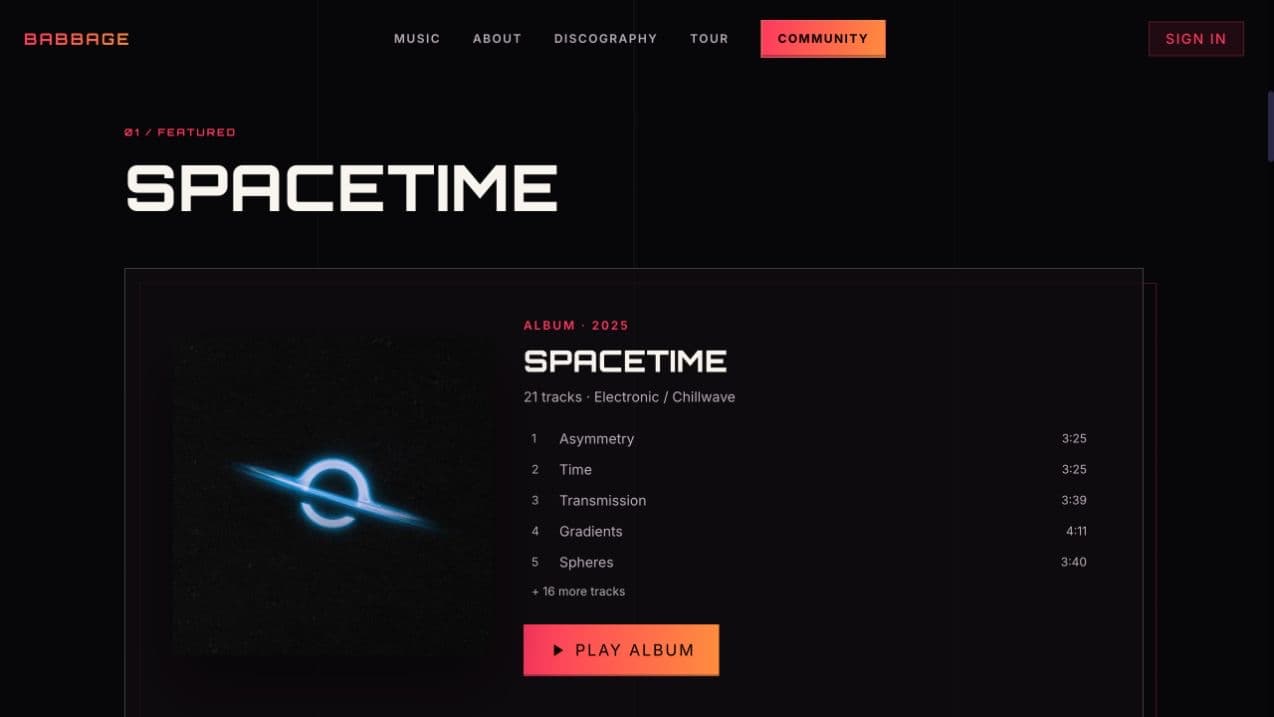
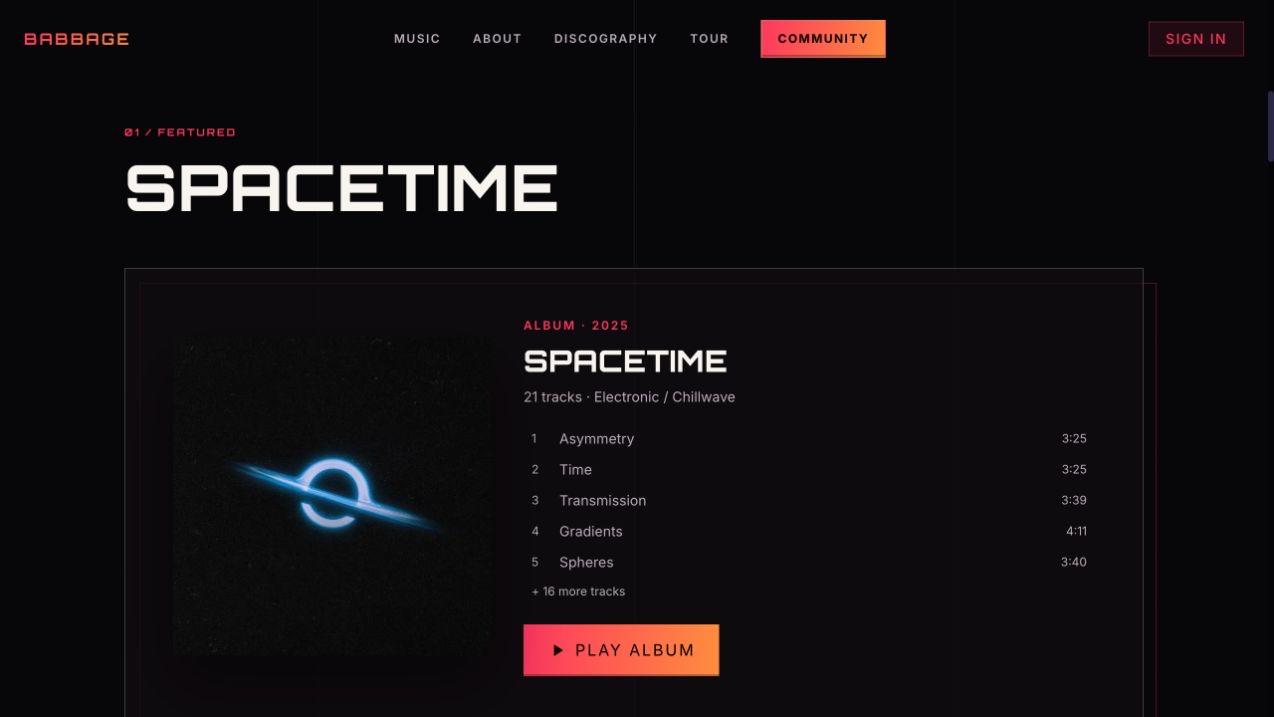
Babbage is our founder’s music project, and its website is work we build and operate ourselves. We checked the public featured-album and album-detail pages and inspected committed catalog, player, and purchase-state code. This is an owned-product story, not a commissioned artist website or a claim about audience growth.
The first page gives the music a clear entrance.
The public site introduces the artist and gives Spacetime a featured album panel. Artwork, release format, a short track list, and the listening action share that space. A visitor can recognise the release before choosing whether to explore it.
The album detail page then provides the full track list, durations, listening, sharing, purchase, and existing-purchase entry points. The two pages have different information density while retaining the artist’s typography and colour treatment.
The captures show actual public pages and released music. We do not use stream counts, awards, or homepage statistics to claim that the website caused an artist outcome.
A release needs an identity beneath its presentation.
Committed catalog code distinguishes releases by ID and slug and groups albums and singles by format. Track selection uses track IDs, and its top-track selection avoids adding the same track twice. These are small details that keep browsing and playback connected to particular records.
For a custom site, this is a useful separation: the public address and visual presentation can evolve while the underlying product, media, or work item still needs a stable identity.
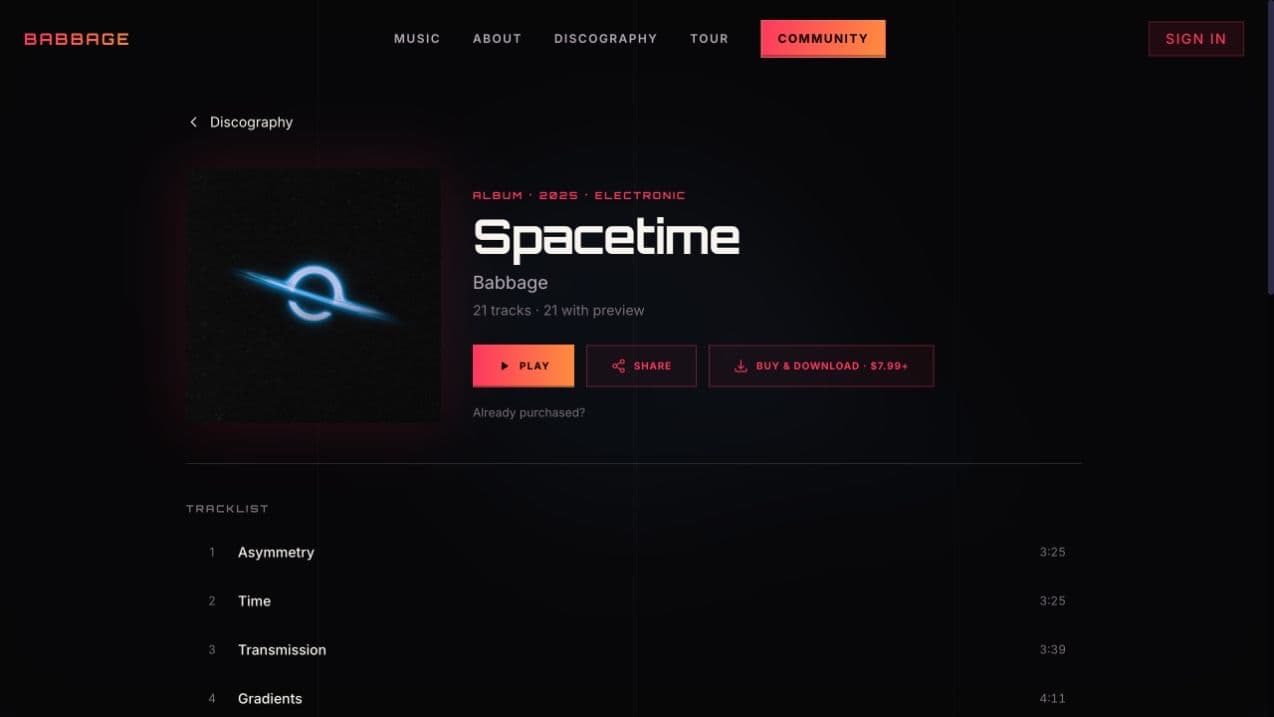
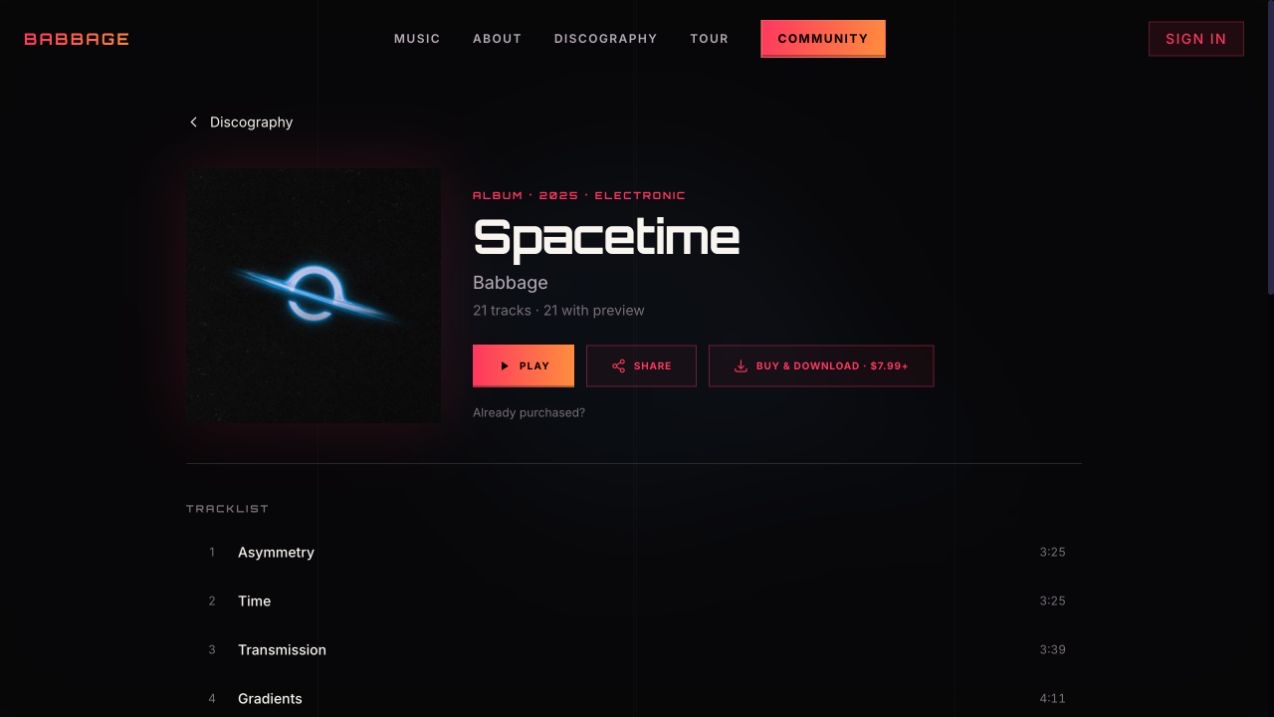
Listening is a sequence, not a set of isolated buttons.
The committed audio provider keeps the current track and release, playback state, and a queue of playable tracks. Selecting a track builds a queue within the release; the end-of-track handler can move to the next available item. Pause, resume, next, previous, and stop have separate behaviours.
That structure makes the player a part of the application rather than a decorative button on every card. It also creates work around unavailable media, browser restrictions, loading, and a person changing their mind. Those conditions deserve explicit verification before making playback guarantees.
We inspected the source and visible controls without running audio or a cross-device playback suite. A Play button in a screenshot demonstrates an entry point, not successful playback under every condition.
A remembered purchase still needs checking.
The release component can remember a purchase reference locally and ask the server to verify it. The Stripe-session branch of the verification route checks the session’s payment status; another branch handles purchase records stored in the application. Those paths should not be described as one universal payment-proof rule.
The interface also separates buying from returning to an existing download. We did not exercise either transaction path or inspect private purchase records.
The transferable design question is how to keep local convenience separate from authority. Remembering where someone left off can help them return, while the application must decide which record and entitlement they are actually allowed to use.
The same music can have a different front door.
Spacetime appears on both Babbage’s artist site and the Velveteen Records label site. The artist site foregrounds one identity; the label site supports a roster. Their public pages and inspected catalog code show different presentations of related music records, not proof of instantaneous synchronisation.
For a custom application, the lesson is to decide which information is shared and which experience serves a particular audience. Keep the record’s identity, current state, and next action coherent while the visual design changes around them.
This story establishes public interfaces and source-level product decisions. It does not establish completed purchases, download authorisation quality, commercial growth, or a measured effect of the design.
Design around a journey through the site.
A distinctive page still needs coherent records and state.
- Identity
- Which stable record is behind the page, card, and media?
- Sequence
- What happens after the first action or when the current item finishes?
- Return
- What can be remembered, and what must be verified again?
- Audience
- Which facts are shared, and which presentation fits this person?
See the product for yourself.
We checked the public product pages and the implementation behind the workflows on October 11, 2026. These links let you explore the public experience.